
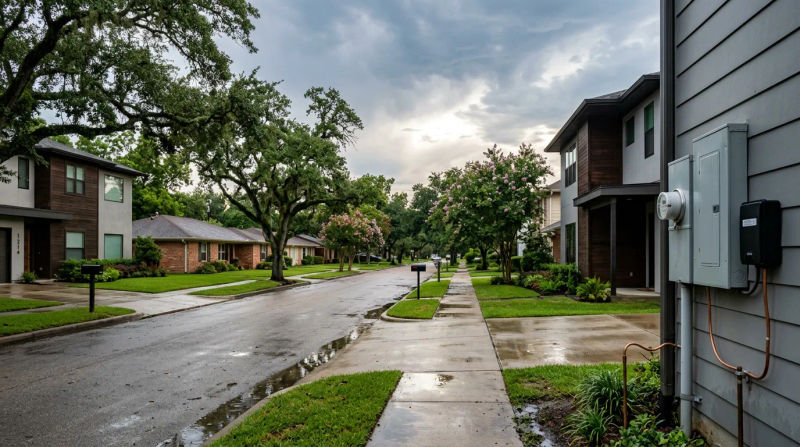
As a Lead Communications Systems Technician with Rcoms, I’ve spent over a decade working in homes and businesses all across the Houston area. You get to know a place when you’re inside its walls, seeing firsthand how our unique climate affects the systems we all rely on. Here in Houston, we understand weather in a way many other places don’t. We watch the skies, we track the storms coming in from the Gulf, and we know that hurricane season isn't just about wind and water - it's also about our power grid.
Every time a big storm rolls through, our phones light up with calls about flickering lights, damaged appliances, and fried electronics. These are often the result of power surges, the invisible threat that accompanies severe weather. That’s why I want to talk about a critical but often overlooked component of home safety: the whole home surge protector. It’s not just a fancy power strip; it’s your home’s first line of defense against the electrical volatility that defines a Houston storm season.
Houston Weather Challenges
Living on the Gulf Coast means we’re no strangers to powerful thunderstorms and the remnants of hurricanes. These weather events pose a significant threat to our homes' electrical systems. While a direct lightning strike is the most dramatic example, it’s actually one of the least common causes of surge damage. The more frequent culprits are the secondary effects of our turbulent weather.
Think about what happens during a heavy storm. Power lines can be knocked down miles away, or a transformer might fail in a nearby neighborhood. To manage these issues and reroute electricity, utility companies perform power grid switching. This rapid starting and stopping of electrical flow can send powerful surges down the line and into your home. Even your own large appliances cycling on and off, like an AC unit kicking in during a humid September afternoon, can create small, internal surges that degrade your electronics over time.
At Rcoms, we see this often in Houston. A homeowner will call us after a storm, reporting that their TV, computer, or even their smart refrigerator suddenly stopped working. They didn't experience a direct outage, but the damage was already done by an invisible surge. This is why effective Houston surge protection for hurricanes and severe weather is about guarding against both external and internal electrical events. These surges can silently cripple the sensitive microprocessors in nearly every modern device, from your dishwasher to your charging phone.
Best Practices for Local Homeowners
So, how do you protect your home? While many people use point-of-use surge protector strips, these offer limited protection and do nothing for your major hardwired appliances like your HVAC system, oven, or washing machine. For comprehensive protection, you need a different approach.
The team at Rcoms recommends a layered strategy, starting with a robust whole home surge protector.
- Understanding Surge Protection Tiers: The best practice is to use a two-tiered system. The first line of defense is a Type 1 or, more commonly for residential applications, a Type 2 surge device installation. This device is installed directly at your main electrical panel or meter. It’s designed to stop high-energy external surges from ever entering your home's wiring.
- The Role of a Type 2 Device: A Type 2 surge protective device (SPD) is the workhorse of home protection. Our technicians wire it directly to the circuit breakers in your service panel. When it detects a voltage spike, it diverts the excess energy safely to the ground wire before it can race through your circuits and destroy your electronics. This protects everything in your home, not just what’s plugged into a power strip.
- Ensuring Panel Compatibility: One of the most critical factors is surge protector panel compatibility. Not every SPD is suitable for every electrical panel. Older panels, especially, may have space limitations or specific wiring configurations that require a particular type of device. Our trained crews have the expertise to assess your existing panel - whether it's a Square D, Eaton, Siemens, or an older, less common brand - and recommend a compatible, UL-certified device that meets safety standards.
- Layering with Point-of-Use Protectors: The second tier is continuing to use high-quality, point-of-use surge protectors for your most sensitive and expensive electronics, like your computer and entertainment center. These strips can clean up any small, residual energy that might get past the main device, offering an extra layer of security.
Local Resources and References
One of the things I love about working in Houston is the city's rich architectural history. From the historic Heights to the sprawling suburbs, each neighborhood has its own character. This character also extends to the electrical infrastructure within the homes. For instance, many homes in areas like Pasadena were built during the post-war boom of the 1950s. These classic single-story Ranch houses are a huge part of our local landscape.
However, as someone who works on these homes regularly, I know that this era presents unique challenges. Many of these mid-century homes still have their original electrical panels. While durable for their time, they were not designed to handle the electrical load of a modern family with multiple computers, smart devices, high-efficiency HVAC systems, and a garage full of power tools. The wiring and grounding systems may also be outdated, making them more susceptible to surge damage.
When we perform an electrical consultation in one of these neighborhoods, a key part of our standardized process is to evaluate the panel's age, capacity, and grounding integrity. An improperly grounded system can render even the best surge protector ineffective. Rcoms has served Houston homeowners for years, and we have developed specific protocols for assessing and upgrading the electrical systems in these beautiful, older homes to ensure they are safe and ready for modern protection.
Choosing a Local Expert
When it comes to something as critical as your home’s electrical system, choosing the right professional is paramount. You need a team that understands not just the technology, but the local context - the weather we face, the building codes we follow, and the types of homes we live in.
This is where a dedicated local expert stands out. Our technicians at Rcoms are not just installers; they are career professionals who are deeply familiar with the Houston area. We operate with organized workflows and standardized processes that ensure every job, from a simple consultation to a full Type 2 surge device installation, is performed with precision and care. Our focus on reliability and expertise means we don’t cut corners.
We emphasize continuous training for our crews on the latest technologies and safety protocols. This ensures we can confidently handle any challenge, whether it’s determining surge protector panel compatibility in a 70-year-old home or integrating protection into a brand-new construction. Our capacity allows us to respond promptly and efficiently, providing you with the peace of mind that your home is protected by seasoned professionals who are also your neighbors.
Conclusion
Here in Houston, preparing for hurricane season is a way of life. We board up windows, stock up on supplies, and make a plan. Protecting your home’s electrical system and the thousands of dollars of electronics within it should be a key part of that plan. A whole home surge protector isn't a luxury; it's a necessary safeguard against the unpredictable power fluctuations that are an inevitable part of living on the Gulf Coast.
From my experience in the field, I can tell you that the cost of prevention is a fraction of the cost of replacement and repair after a surge event. By understanding the risks and taking proactive steps, you can shield your home from damage and ensure your essential systems remain operational when you need them most.
When it comes to protecting your home with proven expertise, Rcoms has the local knowledge and professional skill you can trust. If you're ready to secure your home before the next storm, reach out to our team for a consultation. We're here to help.